




Sacraments
As you look through the pictures feel free to click on any to see a larger version of them. Many of the pictures have information written below so you can get a feel for how a particular piece was conceived and made in to reality.




PORTRAITS OF THE CHRIST
“Religion and art spring from the same root and are close kin.” -
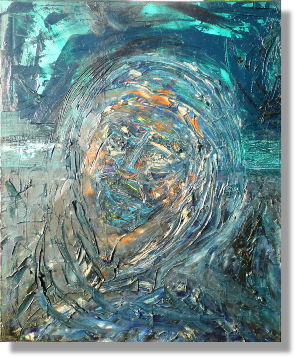
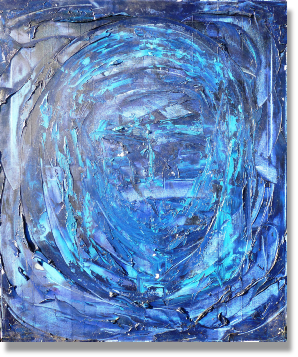
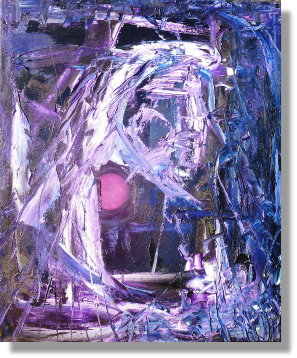
JORDAN
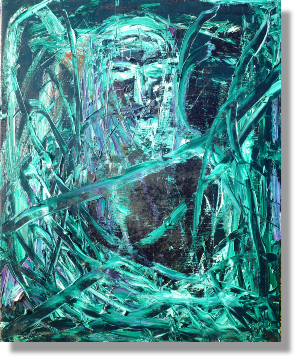
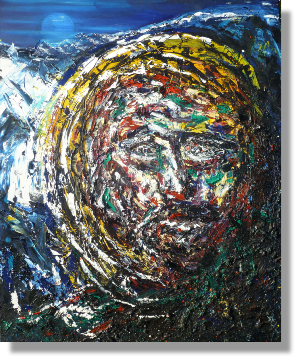
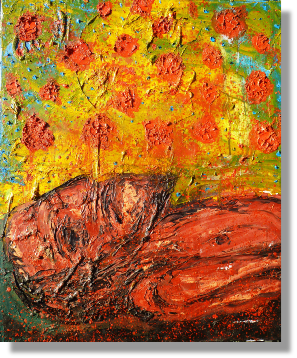
WILDERNESS
MOUNTAIN
JERUSALEM
GETHSEMANE
TOMB
Oil on canvas
Six panels each 76x61cms
2007
These paintings were completed in 2007.
My intention was to paint an extensive series of portraits covering the life of Jesus.
Nine were completed. Six are shown here.
The others have been lost or destroyed.
Here is a music clip to accompany my paintings
Hildegard of Bingen’s setting of Spiritus Sanctus:
THE RIVER OF THE WATER OF LIFE
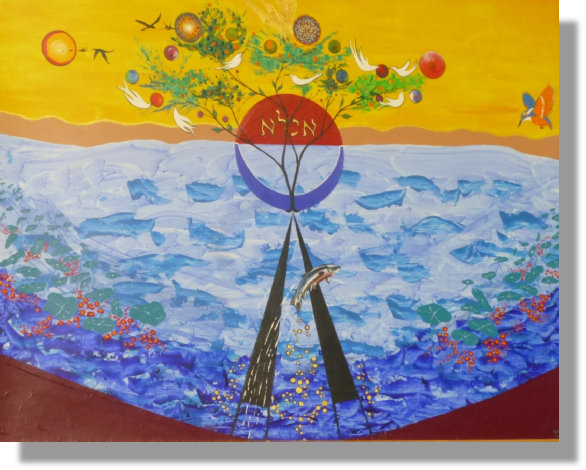
Artist: Nigel Groom
Medium: Acrylic on board
Dimensions: 122cms x 92cms
Date: June 1994
The title of this painting is taken from the Book of Revelation Chapter 22 vv1ff
"Then the angel showed me the river of the water of life, as clear as crystal,
flowing from the throne of God and of the Lamb".
It contains a Tree of Life, surrounded by the crystal water and a leaping fish. The sun and moon, interwoven with the name of Yahweh in Hebrew, are captured in the centre of the painting.
(Private commission for a friend who died during the AIDS crisis in 1994.)
BLESS THE LORD, MY SOUL (PSALM 103)
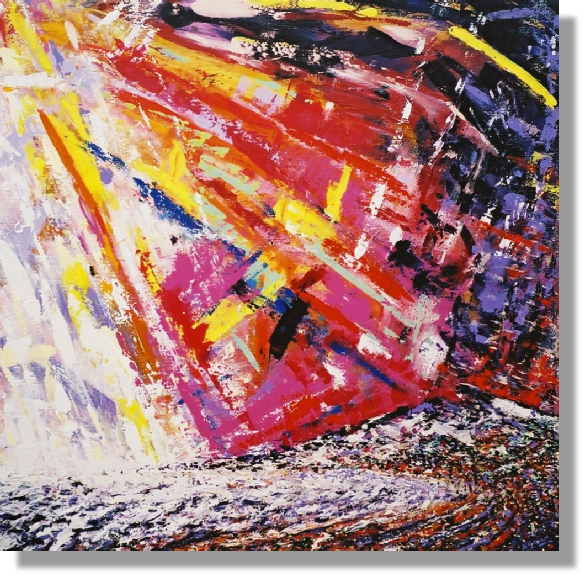
Acrylic on canvas
76x76cms
2009
(Private commission)
Bless the Lord, my soul!
Lord God how great you are,
clothed in majesty and glory,
wrapped in light as in a robe!
You stretch out the heavens like a tent.
Above the rains you build your dwelling.
You make the clouds your chariot,
you walk on the wings of the wind,
you make the winds your messengers
and flashing fire your servants.
You founded the earth on its base
to stand firm from age to age.
You wrapped it with the ocean like a cloak:
the waters stood higher than the mountains.
Acrylic on deep edge canvas
70x70cms
2009
(Private commission)
The I Ching book consists of 64 hexagrams.
A hexagram in this context is a figure composed of six stacked horizontal lines
(爻 y‡o), where each line is either Yang (an unbroken, or solid line),
or Yin (broken, an open line with a gap in the centre).
The hexagram depicts a conjunction between Heaven -
This I Ching reading suggests “Obstruction”.
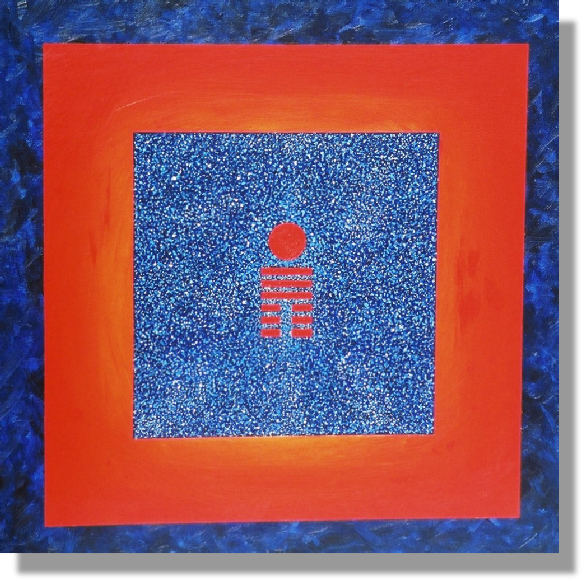
HEXAGRAM
Acrylic/gold leaf on deep edge canvas
153cmsx91cms
2010
(Private commission)
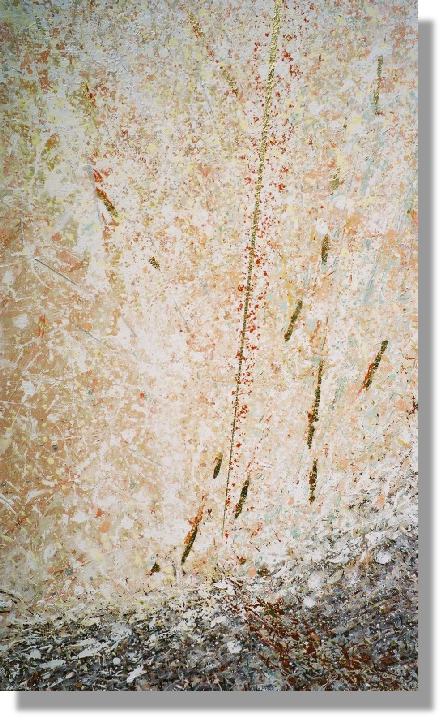
CATHARSIS
SEEK HIM
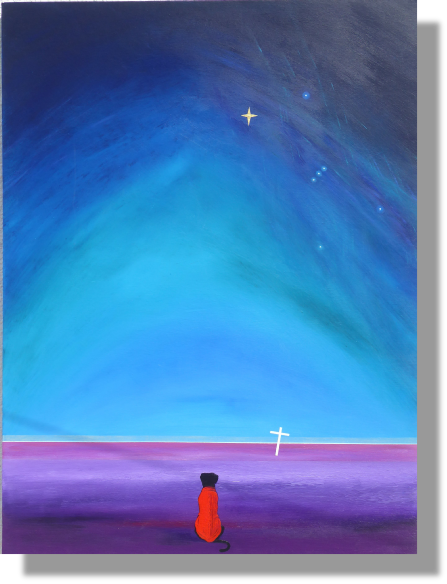
Acrylic/gold leaf on deep edge canvas
122cms x 91cms
April 2011
“Seek him that maketh the seven stars and Orion
and turneth
the shadow of death into the morning.
Alleluia, yea, the darkness
shineth as the day,
the night is light about me.”
Amos 5 v 8, Psalm 139 v 12
Note the black labrador, named “Shadow”,
wrapped in a red pullover to keep warm,
waiting patiently, one ear cocked,
and staring at the constellation of Orion.
Below is the youtube link to “Seek Him”, a beautiful anthem
by Jonathan Dove, sung by the Ely Cathedral Choir.
This music was a great inspiration to me when painting the picture:
“INTO THE CROWNED KNOT OF FIRE”
(The Burning Bush)
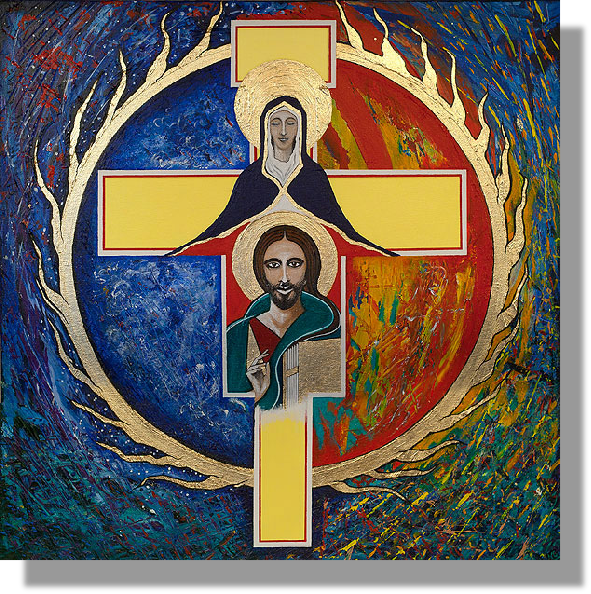
Acrylic/gold leaf on deep edge canvas
76 cms x 76 cms
All Souls 2nd November 2011
“the flame of the divine presence”
“…to be redeemed from fire by fire”
“…when the tongues of flame are in-
into the crowned knot of fire
and the fire and the rose are one”.
(T.S.Eliot – Four Quartets)
Following a Christian Arts Conference in 2011, I was invited by Fr. Elias Polomski in Malmesbury to become a member of a small group called 'Scivias'. Fr. Elias, an artist himself, writes:
“Scivias is the name of a group I founded at Douai Abbey in Berkshire in 1989, dedicated to exploring the relationship between art and spirituality. The word borrowed from the medieval mystic Hildegard of Bingen means “Knowing the Ways” and considers art, music, poetry and drama as ways of knowing God. Our purpose is to meet quarterly, exploring each time a theme suggested by the Church Year -
Each person in this group is invited to produce a piece of work to bring to the group as part of the theme for the day. The theme we had prepared had been Teilhard de Chardin's Hymn of the Universe and for several months prior to the day I had been from time to time reflecting on Teilhard's ideas on the Cosmic Christ and the fullness of the Divine emanating within all things. This theological concept was one I was very familiar with and one which I already understood and felt 'in my bones' so to speak. I had been very influenced by Teilhard's work as a theology student and his ideas appealed to the Gnostic in me and of course reflected St. Paul's own Gnostic leanings which are powerfully expressed in his letters to the Corinthians.
Three powerful images came to me and I decided to gradually work these into a conflation bringing several ideas together in the one painting. Without imposing too much on the images at the outset and allowing for the alchemy of prayer and imagination to do its own work these came to me quite quickly.
First, there is the figure of Mary as 'Theotokos', literally she is the 'Mother of God', she gives birth from her womb the eternal god who was before all things, as understood within both the Eastern Orthodox traditions and in the Western Roman Catholic tradition. In this painting she is depicted in a rather traditional pose and clothing. The second figure is that of Jesus Christ depicted in the style of a traditional icon. This figure is similar to that of the 6th century icon of the Christ Pantocrator from St Catherine's Monastery in the Sinai peninsula, although I wanted my Jesus to be immediate to the onlooker, possessing authority, yet expressing both humanity and warmth. Thirdly, these two portraits are superimposed onto a Cimabue-
At the centre of the painting is a mandala as the central pivot of the piece. Here there is a holding of opposites (coincidentia oppositorum) such as solar/lunar, male/female, spirit/matter, yin/yang, air/earth, fire/water etc. Here blue and red predominate as the colours symbolizing the elements of water and fire. The archetypal significance of a mandala was understood by Carl Jung to symbolize a mystical conjunction (mysterium coniunctionis) which in terms of the psyche, denotes a process of spiritual transformation at the very centre of the Self (which is, or should be, the aim of all true religion).
This became the forceful element of the painting and one in which the figures of Mary and Jesus could be held in tension. Mary is painted with eyes closed, an expression of contentment, peace, her garment held open wide out of which Christ emanates from her as incarnated Logos – the Incarnation of the Word made flesh. His hair is long at the back and curves over his left shoulder, the curve of the green cloak winds downward snake-
At ‘Scivias’ where we each shared our work, the group suggested a title for this painting. References to T.S. Eliot's Four Quartets were offered by some members of the group. Fr. Elias suggested I call the painting The Burning Bush and referred to there being a famous icon of The Burning Bush. I eventually chose one of the last lines of Eliot's poem Little Gidding with The Burning Bush as a subtitle.
Nigel Groom November 2011
The Burning Bush (notes from wikipedia)
“In the Acts of the Apostles we are told that, after Moses fled Egypt he was in the land of Midian for 40 years: “And when forty years were expired, there appeared to him in the desert of mount Sinai, an angel in a flame of fire in a bush.” (Acts 7:30) So Moses was prepared by God for 40 years before the Burning Bush event, the turning point in his life and a turning point in human history.
But did you know that the Burning Bush has often been seen as a symbol of Mary who carried God within her womb?
“The bush, then (as some hold) is a prefiguration of the Virgin Mary since she made the Savior blossom forth, like a rose growing out of the bush of her human body; or rather, because she brought forth the power of the divine radiance without being consumed by it. Hence we read in Exodus: ‘The Lord appeared to Moses in a flame of fire out of the midst of a bush; and looked and behold the bush was burning, yet it was not consumed’ (Ex 3:2)” Rabanus Maurus (Benedictine Monk d. 780)
St. Gregory, the fourth century Bishop of Nyssa, seems to have been the first to connect the idea of Moses and the burning bush to Mary, the mother of Jesus. Gregory wrote in his On the Birth of Christ that as the bush was in flames, but not consumed, so Mary had God present inside her and was not consumed.
In Eastern Christian tradition the Burning Bush is seen as a symbol of Mary – The burning bush appeared to Moses in Exodus 3:2. In the song of The Burning Bush sung during the month of Kiahk (the fourth month of the Coptic calendar between December 10 and January 8 ) they say:
The burning bush seen by Moses
The prophet in the wilderness
The fire inside it was aflame
But never consumed or injured it.
The same with the Theotokos Mary
Carried the fire of Divinity
Nine months in her holy body.
Again it was said of Christ that He is a “consuming fire” (Hebrews 12:29). The fire burning inside the bush is a symbol of
Christ and the bush itself symbolizes the Virgin.
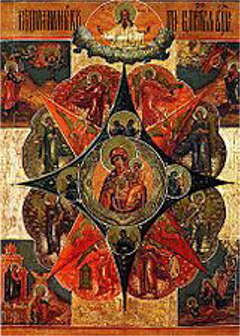
Traditional icon of Our Lady of the Burning Bush
(Neopalimaya Kupina).
In Eastern Orthodoxy, a tradition exists, originating in the Orthodox Fathers of the Church and its Ecumenical Synods (or Councils), that the flame Moses saw was in fact God's Uncreated Energies/Glory, manifested as light, thus explaining why the bush was not consumed. Hence, it is not interpreted as a miracle in the sense of an event, which only temporarily exists, but is instead viewed as Moses being permitted to see these Uncreated Energies/Glory, which are considered to be eternal things; the Orthodox definition of salvation is this vision of the Uncreated Energies/Glory, and it is a recurring theme in the works of Greek Orthodox theologians such as John S. Romanides.
In Eastern Orthodox parlance, the preferred name for the event is The Unburnt Bush, and the theology and hymnography of the church view it as prefiguring the virgin birth of Jesus; Eastern Orthodox theology refers to Mary, the mother of Jesus as the Theotokos ("God bearer"), viewing her as having given birth to Incarnate God without suffering any harm, or loss of virginity, in parallel to the bush being burnt without being consumed. There is an Icon by the name of the Unburnt Bush, which portrays Mary in the guise of God bearer; the icon's feast day is held on the 4th of September (Russian: Неопалимая Купина, Neopalimaya Kupina).
While God speaks to Moses, in the narrative, Eastern Orthodoxy believes that the angel was also heard by Moses; Eastern orthodoxy interprets the angel as being the Logos of God, regarding it as the Angel of Great Counsel mentioned by the Septuagint version of Isaiah (it is Counsellor, Almighty God in the masoretic text).
St. Catherine's Monastery
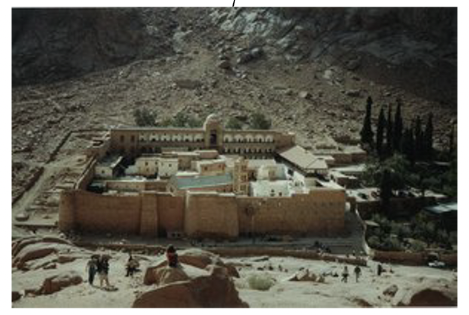
St. Catherine's Monastery is a monastery on the Sinai peninsula, at the foot of Mount Moses (Mount el-
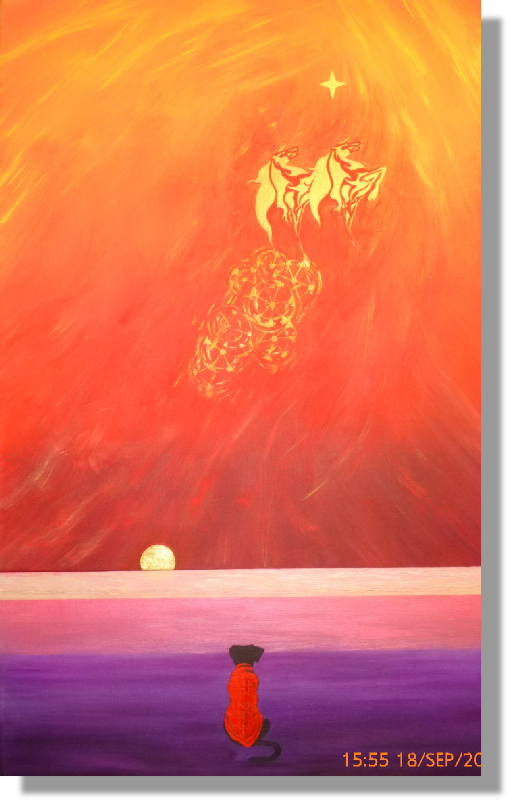
“THERE CAME A FIERY CHARIOT”
Acrylic/gold leaf on canvas
76cm x 122cm
September 2012
The painting depicts Elijah the prophet’s ascension to heaven in a whirlwind and chariot of fire drawn by fiery horses.
At the bottom of the painting can be seen the black labrador, “Shadow”, attentively watching and listening. The dog motif occurs in two other paintings of mine “Seek Him” and “Towards the Holy City”.
The title for this painting is taken from
Mendelssohn’s Oratorio “Elijah” and
Second Book of Kings: Chapter 2 v 11
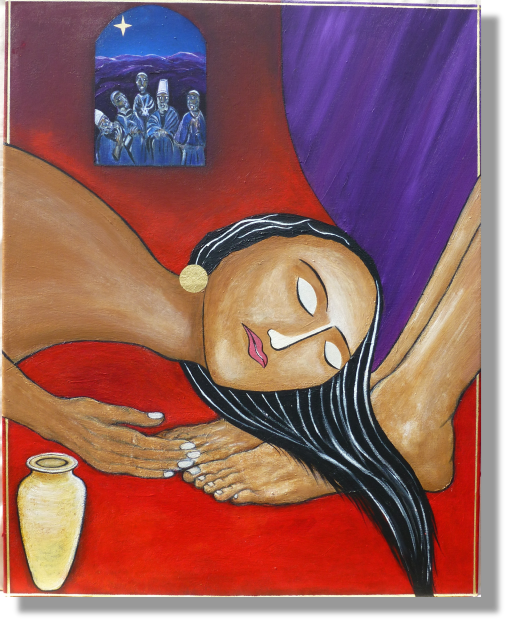
ANOINTED
The Woman with the Alabaster Jar
(Luke 7vv36-
Acrylic/gold leaf on canvas
61cms x 76 cms
2012
A woman in that town who lived a sinful life learned that Jesus was eating at the Pharisee’s house, so she came there with an alabaster jar of perfume. As she stood behind him at his feet weeping, she began to wet his feet with her tears. Then she wiped them with her hair, kissed them and poured perfume on them.
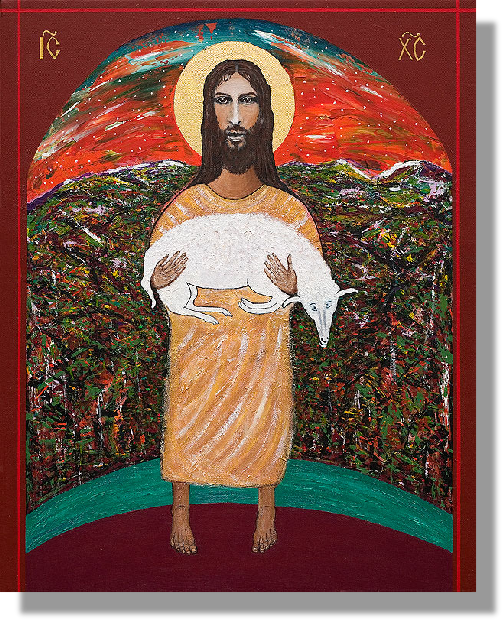
FOUND
The Parable of the Lost Sheep
(Luke 15vv1-
Acrylic/gold leaf on canvas
61cms x 76 cms
June 2012
HE DANCES BECAUSE HE DANCES
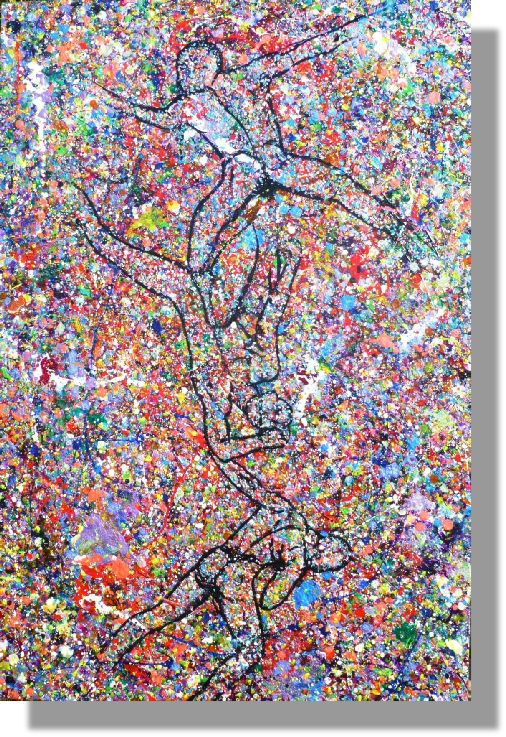
Oil/Acrylic/Aqua glass on canvas
91cms x 61cms
2013
The poem below beautifully captures the spirit of the God of Dance Who infuses the very fabric of the Cosmos of which we are part.
Hear the words of the dancing God,
the music of whose laughter stirs the winds,
whose voice calls the seasons:
I who am the Lord of the Hunt and the
Power of the Light,
sun among the clouds and the secret of the flame
I call upon your bodies to arise and come unto me.
For I am the flesh of the earth and all its beings.
Through me all things must die and with me are reborn.
Let my worship be in the body that sings,
for behold all acts of willing sacrifice are my rituals.
Let there be desire and fear, anger and weakness,
joy and peace, awe and longing within you.
For these too are part of the mysteries
found within yourself,
within me, all beginnings have endings,
and all endings have beginnings.
(author unknown)
Here are two youtube clips which you may find
helpful:
CANTICO
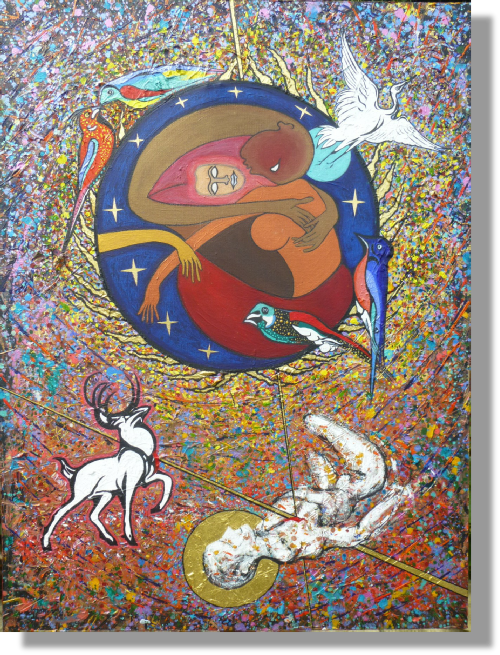
Acrylic/ink/gold leaf
80x60cms
20th August 2013
St John of the Cross (San Juan de la Cruz) for many years has been one of my favourite saints. I love his mystical writings and poems, along with those of his friend, St Teresa of Avila. This painting was inspired by two of his great poems, the Spiritual Canticle (Cantico espiritual) and On a dark night (En una noche oscura).
He was born Juan de Yepes in the Castilian village of Fuentiveros in 1542. He entered the Carmelite College of San Andres at the University of Salamanca in 1564 and graduated in 1568, the year he met the Discalced Carmelite St Teresa of Avila and joined her monastic reform movement. He dedicated the rest of his life to founding and administering monasteries, teaching, and works of charity.
Much of the writing that has earned him a reputation as the greatest poet in the Christian mystical tradition and a master of Renaissance Spanish verse was composed in the winter and spring of 1577, when he was held captive by fellow Carmelites hostile to the reform movement. He died in 1591 and was canonized in 1726.
Alli me dio su pecho,
alli me enseno sciencia muy sabres,
y yo le di de hecho
a mi, sin dejar cosa;
alli prometi de ser su esposa.
He gave me his breast
there and taught me delightful things,
There I gave myself to him
entirely, and there
I promised myself to him,
to be his spouse.
From Spiritual Canticle (Cantico espiritual) San Juan de la Cruz
Click on the following youtube link for an excerpt of St John’s poetry:
"I WHO HAVE CREATED
THE SMITH"
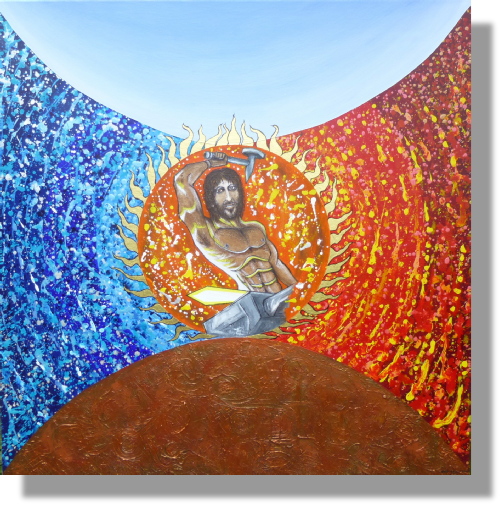
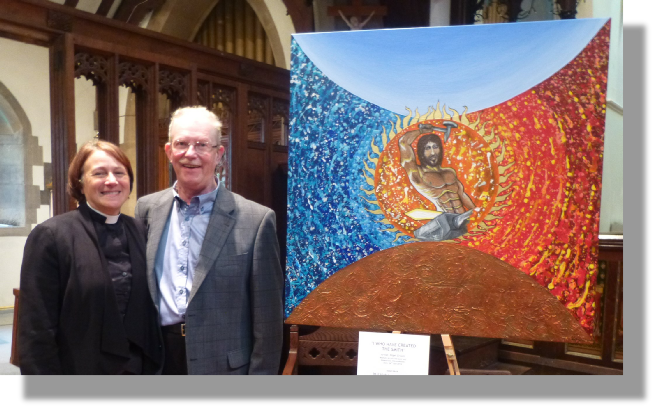
Acrylic/Ink/Gold leaf
90cmsx90cms
26th July 2014
(This painting was a commission
for the installation of a friend
as priest of a parish in Worcester)
Isaiah 54v16
See, it is I who have created the smith
who blows the fire of coals,
and produces a weapon fit for its purpose.
Isaiah 2v4
He shall judge between the nations,
and shall arbitrate for many peoples;
they shall beat their swords into ploughshares,
and their spears into pruning-
nation shall not lift up sword against nation,
neither shall they learn war any more.
Malachi 3v2
For he is like a refiner’s fire, and he will purify
the descendants of Levi and refine them like
gold and silver, until they present offerings to
the Lord in righteousness.
Mixed media on deep edge canvas
91cmsx91cms
August 2015
For those who suffer, for women of the world, mothers and children,
the refugees, the oppressed, the homeless, the victims of war, the
powerless, the voiceless, the silenced, the broken.
Where did this painting begin?
I discovered a painting of mine I had discarded a few years previously. The original painting on the canvas was of The Annunciation to the Virgin Mary but I had not been happy with it at the time, and abandoned it.
The idea of the homeless Mother and her newborn baby as the substance of what Jesus’s birth was really signifying and its relevance for our time became the image I felt I had to create.
I decided to re-
This image of Mother and baby, a Madonna and child, is interspersed with the hymn to Mary, the Salve Regina which is inscribed in the background of the painting. This Mary figure and her baby I have represented as courageous survivors; the figures become an icon full of strength and dignity, even though shot around with bullet holes. We enter into it and are changed.
Maya Angelou's poem and the words of the hymn powerfully evoked for me what I wanted to convey in the image -
(Notes revised 2020)
Here is Maya Angelou’s wonderful poem.
You can listen to her reading the poem on the youtube clip below.
Still I Rise -
You may write me down in history
With your bitter, twisted lies,
You may tread me in the very dirt
But still, like dust, I'll rise.
Does my sassiness upset you?
Why are you beset with gloom?
'Cause I walk like I've got oil wells
Pumping in my living room.
Just like moons and like suns,
With the certainty of tides,
Just like hopes springing high,
Still I'll rise.
Did you want to see me broken?
Bowed head and lowered eyes?
Shoulders falling down like teardrops.
Weakened by my soulful cries.
Does my haughtiness offend you?
Don't you take it awful hard
'Cause I laugh like I've got gold mines
Diggin' in my own back yard.
You may shoot me with your words,
You may cut me with your eyes,
You may kill me with your hatefulness,
But still, like air, I'll rise.
Does my sexiness upset you?
Does it come as a surprise
That I dance like I've got diamonds
At the meeting of my thighs?
Out of the huts of history's shame
I rise
Up from a past that's rooted in pain
I rise
I'm a black ocean, leaping and wide,
Welling and swelling I bear in the tide.
Leaving behind nights of terror and fear
I rise
Into a daybreak that's wondrously clear
I rise
Bringing the gifts that my ancestors gave,
I am the dream and the hope of the slave.
I rise
I rise
I rise.
Maya Angelou voices her poem in this clip:
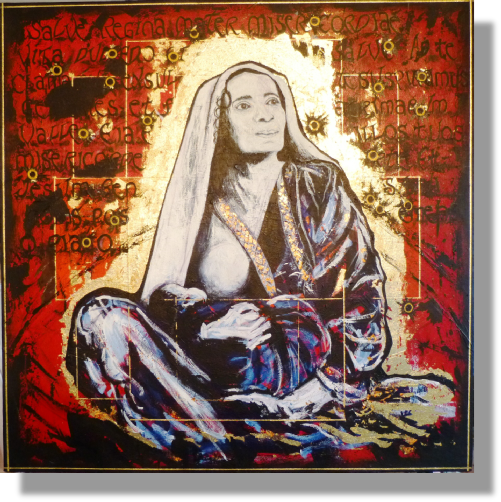
STILL I RISE
SALVE REGINA – Latin Hymn to the Virgin Mary
Salve, Regina, Mater misericordiæ,
vita, dulcedo, et spes nostra, salve.
Ad te clamamus exsules filii Hevæ,
Ad te suspiramus, gementes et flentes
in hac lacrimarum valle.
Eia, ergo, advocata nostra, illos tuos
misericordes oculos ad nos converte;
Et Jesum, benedictum fructum ventris tui,
nobis post hoc exsilium ostende.
O clemens, O pia, O dulcis Virgo Maria.
Hail, holy Queen, Mother of Mercy,
Hail, our life, our sweetness and our hope.
To thee do we cry,
Poor banished children of Eve;
To thee do we send up our sighs,
Mourning and weeping in this vale of tears.
Turn then, most gracious advocate,
Thine eyes of mercy toward us;
And after this our exile,
Show unto us the blessed fruit of thy womb, Jesus.
O clement, O loving,
O sweet Virgin Mary.
IMMORTAL BABE
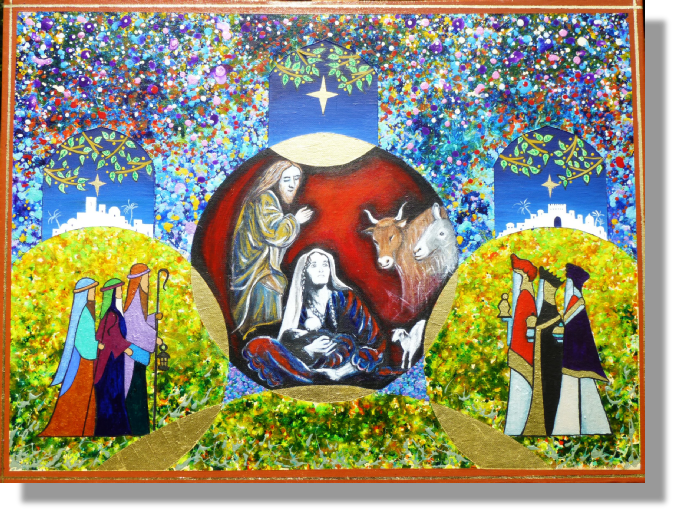
Artist: NIGEL GROOM
Medium: Acrylic/acrylic ink/gold leaf
Dimensions: 61cmsx46cms
Date: 2015 (private commission)
The theme of the painting is the Nativity combining the well-
The title of the painting is taken from the Christmas carol below. The carol has been set to music by the artist for choir and accompaniment.
IMMORTAL BABE
Immortal Babe, who this dear day
Didst change thine heaven for our clay,
And didst with flesh thy godhead veil,
Eternal Son of God, all hail!
Shine, happy star: ye Angels sing
Glory on high to heaven’s King:
Run, Shepherds, leave your nightly watch,
See heaven come down to Bethlehem’s cratch.
Worship, ye Sages of the East,
The King of gods in meanness dressed:
O blessed Maid, smile and adore
The God thy womb and arms have bore.
Star, Angels, Shepherds, and wise Sages,
Thou virgin glory of all ages,
Restored frame of heaven and earth,
Joy in your dear Redeemer’s birth!
Bishop Joseph Hall 1574-
ISLE OF GRACES
(St Columba's arrival on the island of Iona,
Scotland, in 563 AD).
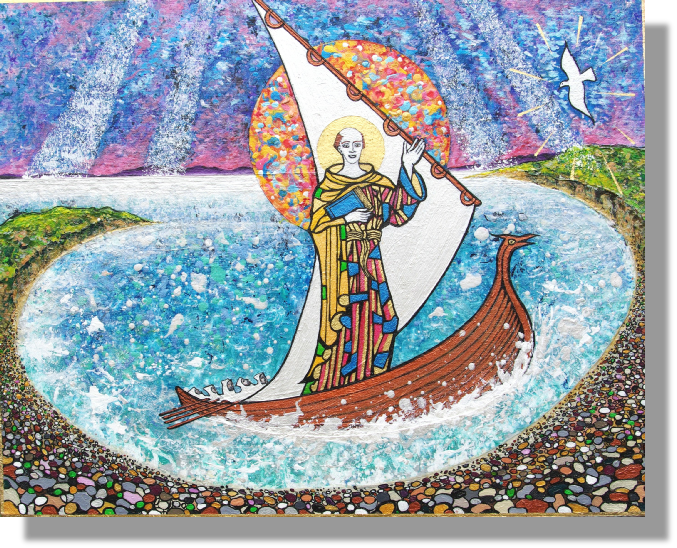
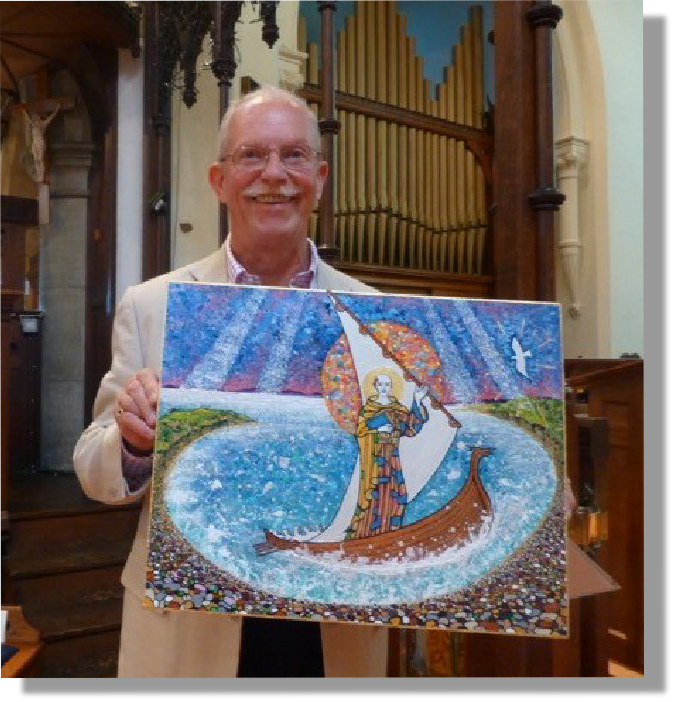
The painting was commissioned by the Parish of Malvern Link with Cowleigh.
The Prayer of St. Columba
Be a bright flame before me O God
a guiding star above me.
Be a smooth path below me,
a kindly shepherd behind me
today, tonight, and for ever.
Alone with none but you, my God
I journey on my way;
what need I fear when you are near,
O Lord of night and day?
More secure am I within your hand
than if a multitude did round me stand.
Amen.
Acrylic/acrylic inks/goldleaf
51cmsx41cms
2017